Monday, September 23, 2013

Make Your Customers’ Day or They Will Make Yours!


“Make your customer’s day”- a well-known statement used for all customer types. And many people will agree if we don’t make our customers happy, they can make our lives complicated. What can be worse than a negative word-of-mouth? Lost customers not only affect your business, but also prevent from attracting new customers.

But keep in mind that unhappy customers are like competitors, they give you an opportunity for change and improvement, they can even give birth to new ideas. Win back every single customer or it will cost your business lots.

In evidence to this I’d like to share an Infographic with some stats on poor customer experience and its cost:


Wednesday, September 18, 2013

Surf the web with us!


On daily bases people use different screen sharing solutions and many of them never think that co-browsing is something different from it. With traditional screen sharing a rep can see everything that’s on the presenter’s computer, including all the open tabs, applications, documents and programs. The rep can also control everything on the presenter’s computer. A great way in dealing with some close friends or relatives, no more!


If you’re a serious company you cannot use screen sharing. It’s a problem for customers who might have a concern allowing a rep to access the entire desktop. In other words it’s a security headache for the companies who want to show some private data. And here the most customer-friendly technology comes to help.

Collaborative browsing, also known as co-browsing is a relatively new technology which enables the simultaneous viewing of specific web pages by more than one individual. It is helpful in solving different problems. Nowadays many companies use it to offer a live help to their customers. Co-Browsing lets the rep to remotely see only the page the customer is on at the moment. Effectively, co-browsing allows a company and a customer to "be on the same page." This makes co-browsing much more secure than traditional screen sharing, especially dealing with sensitive information. No user downloads or installations are needed for co-browsing!

Co-browsing is deployed across nearly every industry starting from online education, insurance companies, banking, governmental segments, etc. (even army uses it to provide a place to meet 24/7 for the people and organizations engaged in keeping the peace). It’s widely used for customer/sales support, shopping, trainings, collaboration, transactions. Imagine how easy it will be to conduct sales using co-browsing! Call center agents use co-browsing to help customers navigate the company website. It’s also useful for group projects requiring joint information access between users. Plus to all its numerous benefits, the most important thing is that co-browsing guaranties security while sharing your web.

Visit LiveLOOK right now and we’ll help you surf the web! Make your web shareable!

Tuesday, September 3, 2013

Twitter - Build Your Brand Awareness!


Twitter became one of the most popular social platforms used by the great part of the companies worldwide. It’s used for broadcasting, engagement, content sharing, driving traffic.

Many companies have more than one twitter account (Dell has 44 Twitter accounts.) Anyway statistics shows that personal accounts have more followers than companies. Here you can see the statistics of the top Twitter accounts for the year 2013.

It was so interesting to read some facts about Twitter that I decided to put the most important ones here. (Most stats provided by Twitter via Hubspot.)

So…

  • Twitter has 105,779,710 registered users
  • 300,000 new users sign up per day
  • There are over 100,000 Twitter applications
  • Twitter receives 180 million unique visitors per month
  • 37% of active Twitter users use their phone to tweet
  • 63% of Brands have multiple accounts
  • 97% of major brands use Twitter(Apple does not use Twitter or any other social media)
  • There are more women on Twitter (53%) than men (47%)
  • New York has the most Twitters users, followed by Los Angeles, Toronto, San Francisco and Boston
  • 21% of users have never posted a Tweet

Did you know?
  • The best time to tweet if you want to be retweeted is on Friday at 4 p.m. EST (says Social media scientist Dan Zarrella)
  • It’s recommended to use a maximum of two hashtags per tweet
  • Weekends are the best time to reach customers on Twitter
  • Tweets with media (a photo/video) get 3 to 4 times more engagement than those without
  • Twitter is good for busy hours (7AM-8PM). This, of course, will depend on your target audience and company type, but mostly it works.
  • Even though the tweet can contain 140 characters, try to use 100 characters (120 at maximum) to make it retweetable. First of all it attracts attention and, secondly, people can add their comments when retweeting.
In one of my next posts I’ll try to put some great free Twitter analytics tools that I ever used to measure Twitter effectiveness.

Sources:

Friday, June 21, 2013

Enhance Customer Service Reputation

Most businesses understand and value customer loyalty, but it can be a challenge to implement strategies which inspire loyalty in their customers. Knowing and understanding the customers’ needs – this is the basic driver behind successful business. The more you know about your customers, the more effective your efforts will be.

Customers want good service – so much so that they are willing to pay more for a product if they are assured of receiving good service along with it. By providing that level of service, businesses can transform many first-time visitors into loyal long-term customers, increasing sales and inspiring referrals from satisfied customers – critical components of ongoing prosperity and success.
However, although much is spoken about the importance of a good customer service, some research suggests that little progress is being made towards improvements in this area:

“The surveys and research available for major markets worldwide make it clear that customer satisfaction indexes haven’t really improved for most industries over the last ten years. In fact, they have only kept steady or even declined”. Seven Customer Contact Trends 2015

Social Media Role

Today, social media plays a strong role in many people’s lives, resulting in customers’ attitude and experiences reflected across different social platforms. While no company likes to be publicly disgraced, when a bad customer experience is made public via social media, a new opportunity is presented. Now a rep has a chance to turn the disgruntled customer into a loyal one by solving the complaint in a good manner.

Research indicates that 62% of customers used social media for customer service, and 47% of social media users said they “actively seek” customer service through social media. 30% of customers prefer social media to the traditional customer service phone call. And 55% expect a response that same day.

Beyond reacting and responding, nowadays many companies use social media to proactively inform their customers about existing problems, and the corresponding resolutions, and in this way avoid complaints.

A reputation for good customer service has become a key factor for businesses. A good social media customer service strategy will ensure success in this area.

Monday, June 17, 2013

Lead Generation – a challenge or a must?

Every now and then we hear about getting new customers, gaining customer loyalty, winning more customers, converting leads into customers, filling sales funnel, etc. and all this is about lead generation.

Lead generation is one of the most critical and challenging components for any business. It’s proved to be responsible for 42% of total sales. Lead generation combines many activities in it, starting with setting objectives → getting visitors → converting them to leads and a good follow up. 


60% of the marketers name lead generation as one of their top three priorities and 26% say it’s their highest priority


17% of marketers spend 15+ hours a week on lead generation”


Lead generation methods can be conducted online and offline. The leads may come from various activities: via the Internet, through calls, through advertisement, list purchase, referrals, telemarketers, and advertisements. Here are some crucial lead generation activities:

Email
  • 42% of businesses name email as one of their most effective lead generation channels
  • 80.8% of users report reading email on mobile devices

Telephone
  •  real-life conversation is the best way to build a connection

Content Marketing
  • 81% of businesses have reported their blog as useful or critical to generating leads
  • 43% of marketers generated a customer via their blog with less than 10% of total time allocation
  •  9% of lead generation companies employ a full-time blogger

Social Media
  • 62% of companies say that social media has become a more important source of leads and 53% of businesses have one person dedicated to social media activities at the company
  • Marketers rate social media as the second-most important factor (64%) in search, behind only strong content (82%)
  • 65% of B2B companies have generated a lead from LinkedIn
  • 77% of B2C companies have generated a lead from Facebook
  • 40% of marketers report that Google+ is critical to their business
  • Businesses with 301 to 1,000 Twitter followers have over 5 times more traffic than those with 1 to 25 followers
  • Companies that use Twitter average double the amount of leads per month than those that do not
  • 83% of Pinterest users are women. In the U.S., the most popular categories are Fashion, Desserts, Clothes and Birthdays

Trade Shows /Conferences

  • 35% of B2B marketers say that ‘live events’ are most effective for lead generation’ pile

Webinars

  • 80% of users said they would register for a whitepaper/ebook, while only 31% would register for a webinar


Search Engine Optimization

  • 61% of global Internet users research products online
  • 57% of B2B marketers say SEO has the biggest impact on their lead generation goals
  • 70% of the links search users click on are organic — not paid
  • 46% of daily searches are for info on products or services
  • 75% of users never scroll past the first page of search results

Surely a good budget is needed for all these activities. According to HubSpot survey where 167 marketing professionals answered how they spent their marketing budgets and how effective each technique was in generating sales leads, the budget breakdown was as follows:


Friday, June 14, 2013

Make the Right Decision - Increase Response Rates!


Survey is a good way of reaching your customers and making future improvements in accordance to their needs. Many companies run surveys on different basis. Some want to better understand the characteristics of people who visit the website, know the level of their satisfaction, others want to clarify some business-related problems, like what customers think about their product, company, why not implement some suggestions and make customers happy.
Some people complete a survey to share their information. But to increase response rates many companies offer incentives, like prizes, gifts and the bigger the prize, the more people will participate in the survey.
“Keep it simple!” became a widely used expression for many activities. It refers to surveys too. I used to complete surveys many times, but the moment I realized the questions are complicated, I quitted it. I believe, I’m not an exception.
The first thing you should do while planning a survey is to write down the whole survey process. Here are some valuable steps you’ll need to consider before creating and running a survey:
  • Define your goals and target audience
  • Pick the tools/service you are going to use
  • Write down some valuable questions
  • Test the survey before sending it
  • Collect responses and monitor progress
  • Measure the results and inform participants about them
All the above points are important in their own way. But more efforts should be applied to the questionnaire. Here are some types of questions:
  • Dichotomous Questions -  offer  a "yes/no" answer
  • Demographic Question - used to identify characteristics such as age, gender, income, race, geographic place of residence
  • Multiple Choice Questions - offer a limited range of possible answers, either one or multiple responses per question
  • Matrix questions - allow the customer to rate a range of products or services by a single set of possible responses
  • Rating Scale Questions  - used to measure the direction and intensity of attitudes
  • Open ended questions - the customer should type the response.  It gives a person the chance to respond in detail. Although open-ended questions are important, they are time-consuming and should not be over-used.
Don’t forget that everyone has different understanding of the facts or different basis of knowledge, so "assure a common understanding". Write questions that everyone will understand in the same way. 
And remember: surveys provide information for decision-making; they don't make decisions on their own!

Wednesday, May 8, 2013

The Traditional Support Channel Persists!

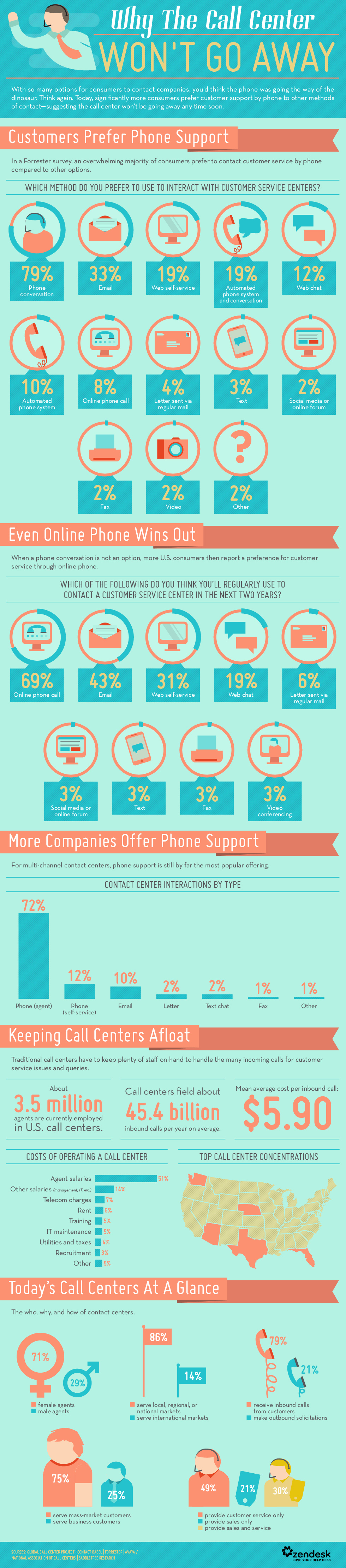
As a confirmation of my last post about call centers continuing to be the center of reliable and customer-friendly communication, I’d like to share an Infographic with some great facts and statistics by Zendesk:

  • 79% of customers still prefer to use the telephone to interact with a customer service center and only 12% prefer to use web chat (though that number continues to climb!)
  • 72% of companies are aware of their customers’ preference and place value on their call centers.
  • An interesting fact about agents’ gender: 71% of agents are female and only 29% male.

Clearly call centers will continue to play a big role in many companies’ success, driving high customer satisfaction scores and ongoing customer loyalty.


Call Centers Infographic